


In this article
Batistuta, Toni, Vlahović: Fiorentina’s history is easiest to remember through its goalscorers. It is a short step from there to believing that Europe requires a number nine who scores twenty. The club’s history gives that theory magnificent names. It does not give it enough successful seasons.
Across all thirty Fiorentina Serie A seasons from 1994/95 to 2025/26, the leading scorer reached twenty seven times. Two of those seasons ended in the top six. In the other twenty-three seasons, with nobody reaching twenty, Fiorentina finished in the top six nine times. The word “only” already falls away.
Does 20 unlock a top-six finish?
That does not suggest great strikers are harmful. It shows that a team’s league position is not their personal statistic. These are league goals for Fiorentina alone; a top-six finish is a league position, not a uniform definition of European qualification. Cups and changing access rules matter.
Batistuta was an answer. He could not be an entire team
Twenty-six goals in 1994/95 brought tenth place. Twenty-one in 1998/99 accompanied third. Twenty-three a year later accompanied seventh. The differences between those outcomes cannot all be found in one striker’s finishing.
Then there is 1995/96: nineteen league goals, fourth place and the Coppa Italia. The missing twentieth should not obscure an excellent season. An extra goal in an already settled match would change our category without changing the quality of that team.
A great scorer allows a side to win without playing a perfect match. He offers an escape when the build-up fails. Trouble starts when the escape becomes the whole plan. A long ball to a striker may produce a goal; repeated without support, it hands the opposition possession and initiative.
Toni requires two truths about the table
His 31 goals in 2005/06 helped win 74 points and fourth place on the field. The thirty-point penalty made the official finish ninth. The table below uses official positions. Treating that ninth as an ordinary sporting failure of Toni’s goals would be misleading: a disciplinary decision changed the classification.
The following season is more revealing about team building. Toni and Mutu scored sixteen each; Fiorentina conceded just 31. Even with a fifteen-point deduction, they finished sixth. There were two substantial sources of goals and a defence that stopped their work dissolving into another draw.
Montella’s three fourth places are more than a minor exception
Mutu led Fiorentina with seventeen in 2007/08, Gilardino with nineteen in 2008/09. Both teams finished fourth. Neither needed a round twenty to be a very good forward in a very good side.
From 2012/13 to 2014/15, Montella’s teams finished fourth three times. Their leading league scorers had thirteen, sixteen and eight: Jovetić, Rossi and Iličić. Eight is Iličić’s Serie A figure, not his total in all competitions. Three consecutive seasons make a substantial counterargument, not a stray exception.
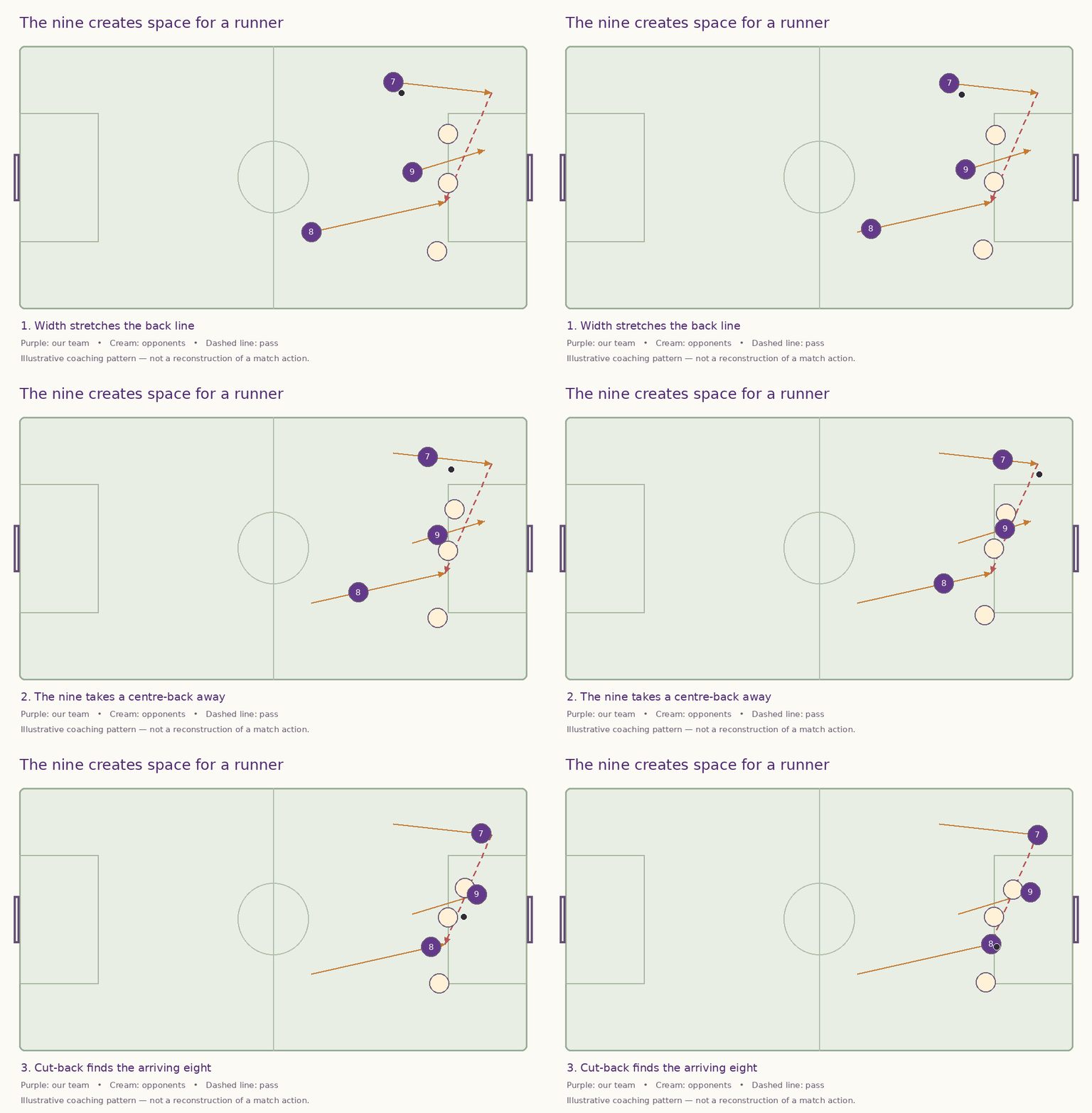
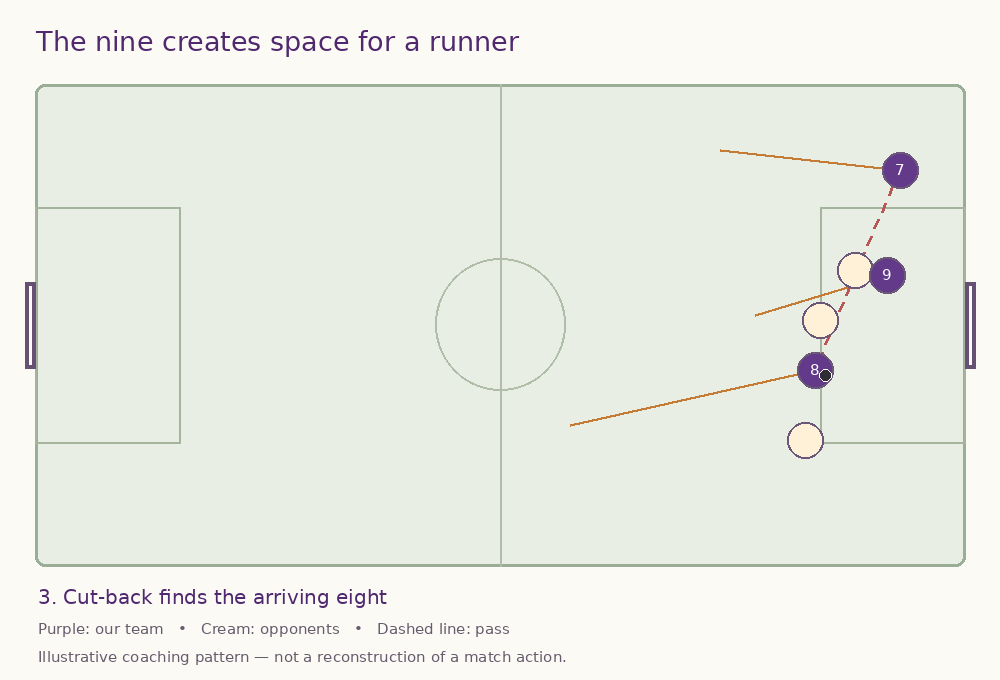
When a winger attacks the finishing position, a midfielder runs beyond and a striker occupies two defenders, the list of scorers grows. The nine may be essential to a goal recorded against somebody else’s name. Recruitment should recognise that work too.
Vlahović: twenty-one goals and thirteenth place
In 2020/21 he scored 21 of Fiorentina’s 47 league goals, almost 45 per cent. The team finished thirteenth and conceded 59. The striker did plenty. The collective needed more because its defending kept raising the price of victory.
Removing his goals from the table would not tell us where Fiorentina would have finished without him: a replacement would inherit minutes and chances. The actual season is enough. Excellent individual scoring did not produce a side of European league quality.
The next year contains an accounting trap. Vlahović finished Serie A with 24 goals, but seven came for Juventus. His Fiorentina total was seventeen. That is the number to put beside Viola’s seventh place.
Kean and the appeal of a simple comparison
Nineteen goals and sixth in 2024/25; eight and fifteenth in 2025/26. The connection is tempting. Yet the play around Kean changed too. This comparison helps frame a question; it cannot establish which change caused the others.
A striker depends on service, but the side also depends on his work away from the ball. A threat behind the defence discourages a high line. Holding a long pass lets the midfield and back line move up. Goals alone do not measure that contribution.
Show the animated tactical pattern
All thirty seasons, including the awkward ones
| Season | Finish | Leading league scorer | Serie A goals |
|---|---|---|---|
| 1994/95 | 10 | Gabriel Batistuta | 26 |
| 1995/96 | 4 | Gabriel Batistuta | 19 |
| 1996/97 | 9 | Gabriel Batistuta | 13 |
| 1997/98 | 5 | Gabriel Batistuta | 21 |
| 1998/99 | 3 | Gabriel Batistuta | 21 |
| 1999/00 | 7 | Gabriel Batistuta | 23 |
| 2000/01 | 9 | Enrico Chiesa | 22 |
| 2001/02 | 17 | Adriano | 6 |
| 2004/05 | 16 | Fabrizio Miccoli | 12 |
| 2005/06 | 9 | Luca Toni | 31 |
| 2006/07 | 6 | Adrian Mutu / Luca Toni | 16 |
| 2007/08 | 4 | Adrian Mutu | 17 |
| 2008/09 | 4 | Alberto Gilardino | 19 |
| 2009/10 | 11 | Alberto Gilardino | 15 |
| 2010/11 | 9 | Alberto Gilardino | 12 |
| 2011/12 | 13 | Stevan Jovetić | 14 |
| 2012/13 | 4 | Stevan Jovetić | 13 |
| 2013/14 | 4 | Giuseppe Rossi | 16 |
| 2014/15 | 4 | Josip Iličić | 8 |
| 2015/16 | 5 | Josip Iličić | 13 |
| 2016/17 | 8 | Nikola Kalinić | 15 |
| 2017/18 | 8 | Giovanni Simeone | 14 |
| 2018/19 | 16 | Marco Benassi | 7 |
| 2019/20 | 10 | Federico Chiesa | 10 |
| 2020/21 | 13 | Dušan Vlahović | 21 |
| 2021/22 | 7 | Dušan Vlahović | 17 |
| 2022/23 | 8 | Arthur Cabral | 8 |
| 2023/24 | 8 | Nicolás González | 12 |
| 2024/25 | 6 | Moise Kean | 19 |
| 2025/26 | 15 | Moise Kean | 8 |
Serie A goals scored for Fiorentina only. The seasons outside Serie A, 2002/03 and 2003/04, are excluded, as is unfinished 2026/27. Official positions include deductions: −30 in 2005/06, −15 in 2006/07. Top six is not identical to Europe: the 2000/01 Coppa Italia win provided qualification.
Buy the conditions for goals as well as the finisher
A strong nine is expensive because he can turn an imperfect move into a goal. That is worth paying for. His contract does not also purchase a functioning midfield, a second source of goals and the ability to protect a lead.
I would assess how consistently a candidate reaches chances, how he moves against different defensive lines and how he links with the wings under pressure. Then I would ask how many teammates arrive when he drags a centre-back away. That is the basis for a scoring projection worth trusting.
Today Pellegrino and Beto have two league goals between them after nine rounds. More production is plainly needed. With twenty-one conceded, however, asking a striker to repair everything would again place the collective burden on one man.
A twenty-goal forward can turn a good team into a very good one. Too often Fiorentina have asked for something harder: to turn a collection of problems into a team. Even the best could not always do it.