1926/27–1951
Florence’s giglio
The stand-alone red lily draws directly on the city’s heraldry. Details varied between early applications and materials.
One giglio. Many visual identities.
From the city’s lily to a digital diamond: Fiorentina’s badge tells a story of changing design and an enduring bond with Florence.
VIOLAPEDIA / HERITAGE
The starting point is the red giglio on white. Founded in 1926, Fiorentina initially wore red and white; purple followed in 1929. The familiar tale of shirts accidentally changing colour in the wash remains a legend, rather than a documented explanation. Badge and shirt colours therefore share their roots while following different histories. [1]
The dates organise the main variants found in badge catalogues. They do not track every shirt application: documents, pennants and kits could use different versions. ViolaPedia’s drawings are editorial reconstructions of the essential compositions, rather than reproductions of the club’s official artwork files. [2], [3]
The stand-alone red lily draws directly on the city’s heraldry. Details varied between early applications and materials.

The lily gains a geometric frame. Catalogues date this badge type from 1951; the angular lily’s documented shirt debut is in 1957.
An elongated white diamond, red outline and finer lily drawing form another variant of the 1960s.
An oval blue surround adds gold details and the name A.C. Fiorentina. The lily remains inside a pale diamond.
A white upper diamond meets a long purple triangle. The ACF monogram becomes part of the structure.
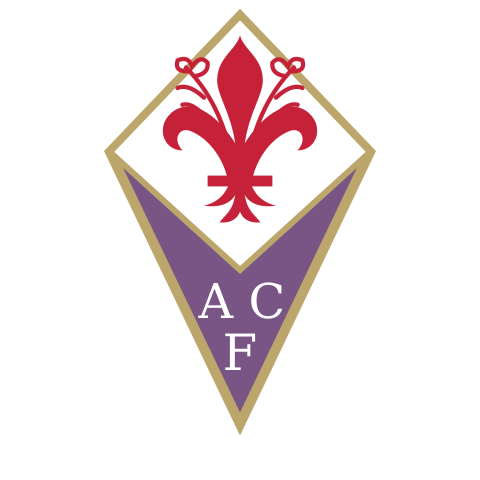
Another gold and purple version adjusts proportions and lily details while retaining the two-part layout.

A bold red circular emblem combines a lily with the letter F: the strongest departure from traditional heraldic drawing.
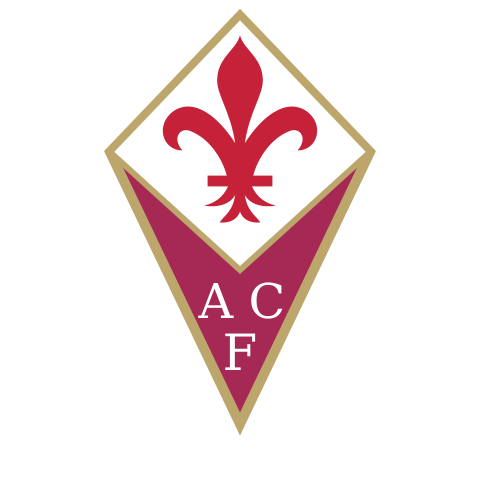
The elongated badge returns with the lily and ACF letters. This version uses a red-purple lower field.
Following bankruptcy and the restart as Florentia Viola, the stand-alone civic lily returns for the rebuilding season in C2.
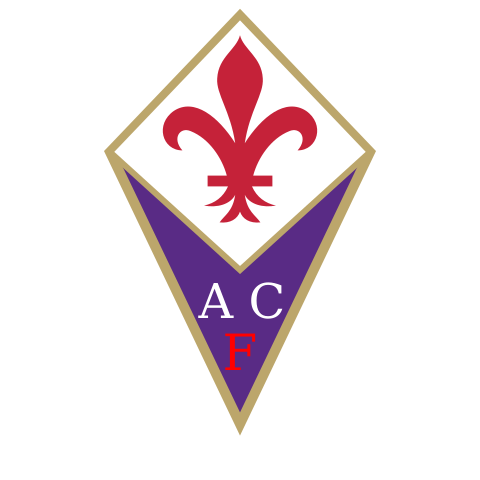
A gold border surrounds the red lily on white and a purple lower field, accompanying the recovered ACF Fiorentina identity.
A compact mark pairs a geometric lily with a prominent V. Unveiled in March 2022 for use from the 2022/23 season.
Museo Fiorentina historian David Bini dates the distinctive geometric giglio’s debut to 28 August 1957. He associates the design with an idea by Marquis Luigi Ridolfi, presented to president Enrico Befani. It appeared on shirts from 1957 to 1967. This qualifies catalogues that place a similar white diamond earlier in the 1950s: dating an outer badge shape does not necessarily date the lily drawn inside it. [4]
The new identity was unveiled on 25 March 2022 for the 2022/23 season. FutureBrand simplified the giglio and paired it with a prominent purple V. The gold outline and ACF letters disappeared, while the diamond became more compact. The intention was a legible identity for the whole club, including the women’s team and academy, which would also work at small digital sizes. [5], [6]
The early lily spoke primarily of Florence. The elongated badge with its ACF monogram emphasised the institution’s name. The Pontello era sought a bolder symbolic shorthand. Today’s crest simplifies the composition again. Aesthetic judgement remains personal; historically, the thread connecting these versions is Florence, the red giglio and purple.
A kit can revive a historical lily while the organisation retains its current official identity. Historical references in 2021/22 and on the 2024/25 away shirt illustrate this distinction. A shirt application and the corporate badge therefore need separate dates. [7], [8]
Research and reconstructions: ViolaPedia. The crests identify ACF Fiorentina and belong to the club. Updated: 27 October 2026.