

In this article
Jiménez’s goal kept Fiorentina ahead until stoppage time. Then Thuram equalised and Zieliński converted the winning penalty. The finish was painful, but the warning signs had been there: Inter kept attacking, De Gea made important saves and Carlos Augusto twice hit the crossbar.[1], [4]
- 65′Álex JiménezViola take the lead
- 90+1′Marcus ThuramEqualiser
- 90+8′Piotr ZielińskiPenalty · 2–1
A lead to protect, but little control
Vanoli’s narrow 4–3–2–1 defended mainly inside its own half, with Fagioli tasked with pressing Çalhanoğlu as Inter built up. The hosts looked for width and repeated deliveries. Whenever Fiorentina failed to keep a recovered ball, the defence faced another attack.[1], [3]
These are full-match figures. The 11–2 advantage in shots on target shows how much work Fiorentina’s goalkeeper had to do. It does not make every defensive decision wrong; it helps explain why simply dropping deeper was an incomplete way to protect the score.
65 minutes: a high regain and an exceptional finish
Fagioli won possession in the attacking third and found Jiménez, whose powerful long-range strike beat Provedel. Fiorentina made the most of that regain. It did not lead to a sustained spell of control.[8]
After scoring, Viola needed some possessions that would allow their forward to hold the ball and the defence to step out. A clearance that comes straight back offers only a brief pause, even when the first defensive intervention is successful.
The crossbar offered two warnings
Carlos Augusto twice reached set-piece deliveries and headed against the bar. Chivu later spoke about seeking width and movement from his forwards because the centre was crowded.[5], [7]
Fiorentina had three connected jobs: pressure the delivery, track the runner and collect the loose ball. Winning the first duel was not enough if Inter recovered the next ball and started again.
90+1: Thuram kept moving after his pass
Thuram beat an opponent, exchanged passes with Diouf and finished left-footed into the bottom corner. Fiorentina failed to stop his movement after the lay-off. He gave the ball to a teammate and received it again in a shooting position.[6]
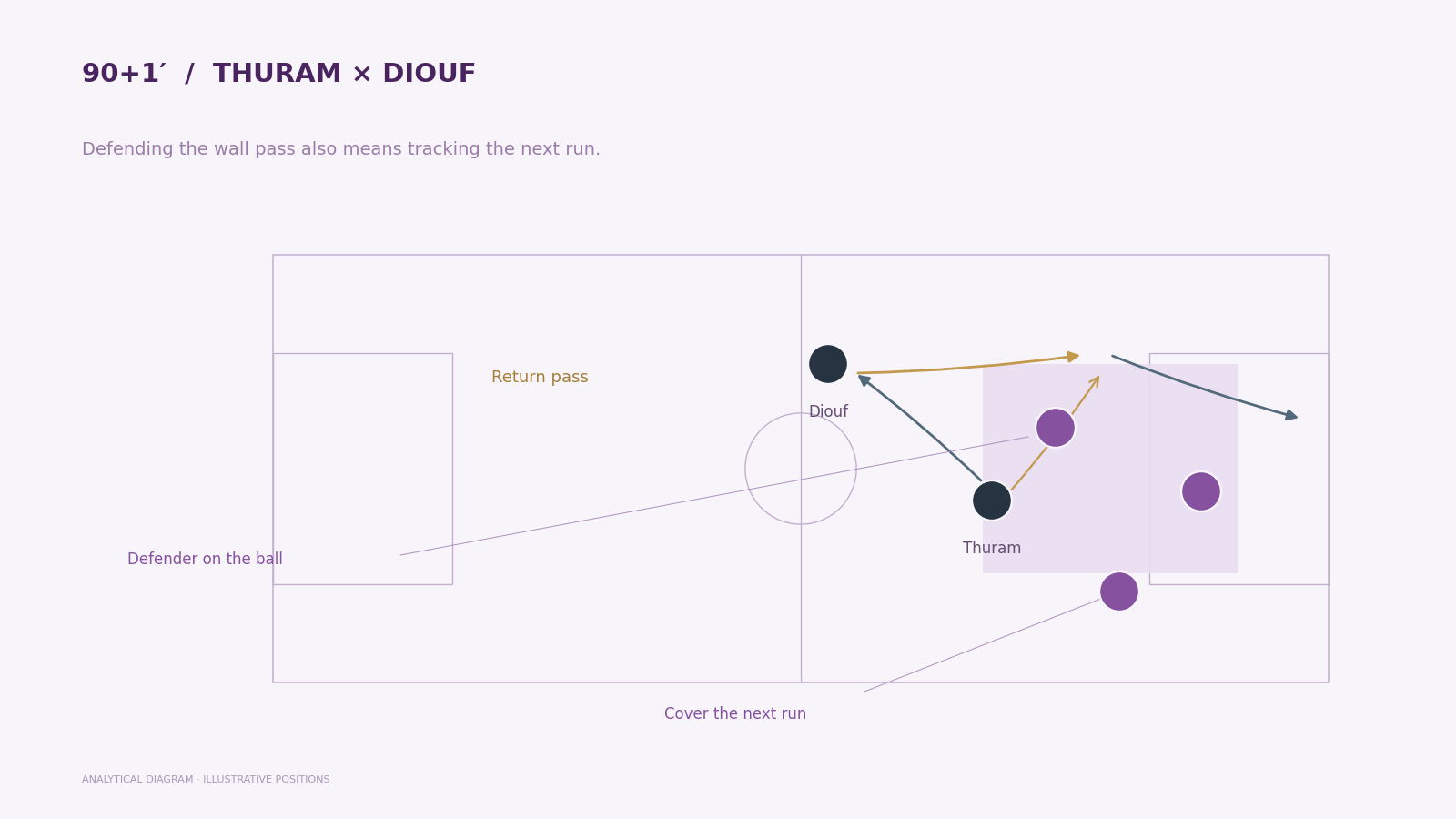
The player stepping towards the ball needed cover: a teammate to close the return pass or pick up Thuram’s run. Written reports do not establish which player had been assigned that responsibility. They do show a combination that Fiorentina failed to interrupt or hand over effectively.
90+8: a late response and a penalty
Akanji crossed from the left, Thuram attacked the space in the box and Valdepeñas held him. Mariani awarded the penalty and Zieliński put Inter ahead.[1], [6]
The hold was Valdepeñas’s direct mistake. Before it, Fiorentina allowed the delivery and lost the striker’s first movement. The defender tried to recover after Thuram had gained an advantage, when the risk of fouling was already high.
Were the substitutions the cause?
Inter refreshed midfield, introduced Dimarco and eventually sent on Lavelli. Fiorentina also made changes while retaining a counter-attacking threat. Gnonto had a chance to make it 0–2 in the 79th minute, only for Provedel to save. Keeping an attacking option was a reasonable choice.[2], [6], [7]
The question is how the altered side worked together: who pressed wide, who covered the middle and who offered a pass after a regain. Another centre-back would not automatically have solved those jobs. Fiorentina’s late defending did not carry them out well enough.
Three tasks before Atalanta
- Buy time after a regain. A nearby passing option matters as much as a runner for the counter.
- Track the next movement. A forward remains dangerous after laying the ball off.
- Defend the delivery at source. Less time for the crosser makes the duel inside the box easier.
Viola could have won at San Siro, but spent long stretches protecting their lead without settling the game. Two ineffective responses inside the box then decided it. Better possession must support the defensive work. Our Fiorentina–Atalanta preview looks at the next test.
Sources and method
Events and figures come from the reports listed below. The tactical reading is our editorial assessment. Diagrams illustrate mechanisms, not tracking-derived player positions. Goal times follow Inter’s Italian match sheet: 65, 90+1 and 90+8; minute notation differs in some reports.